 111
111 2
2 3
3
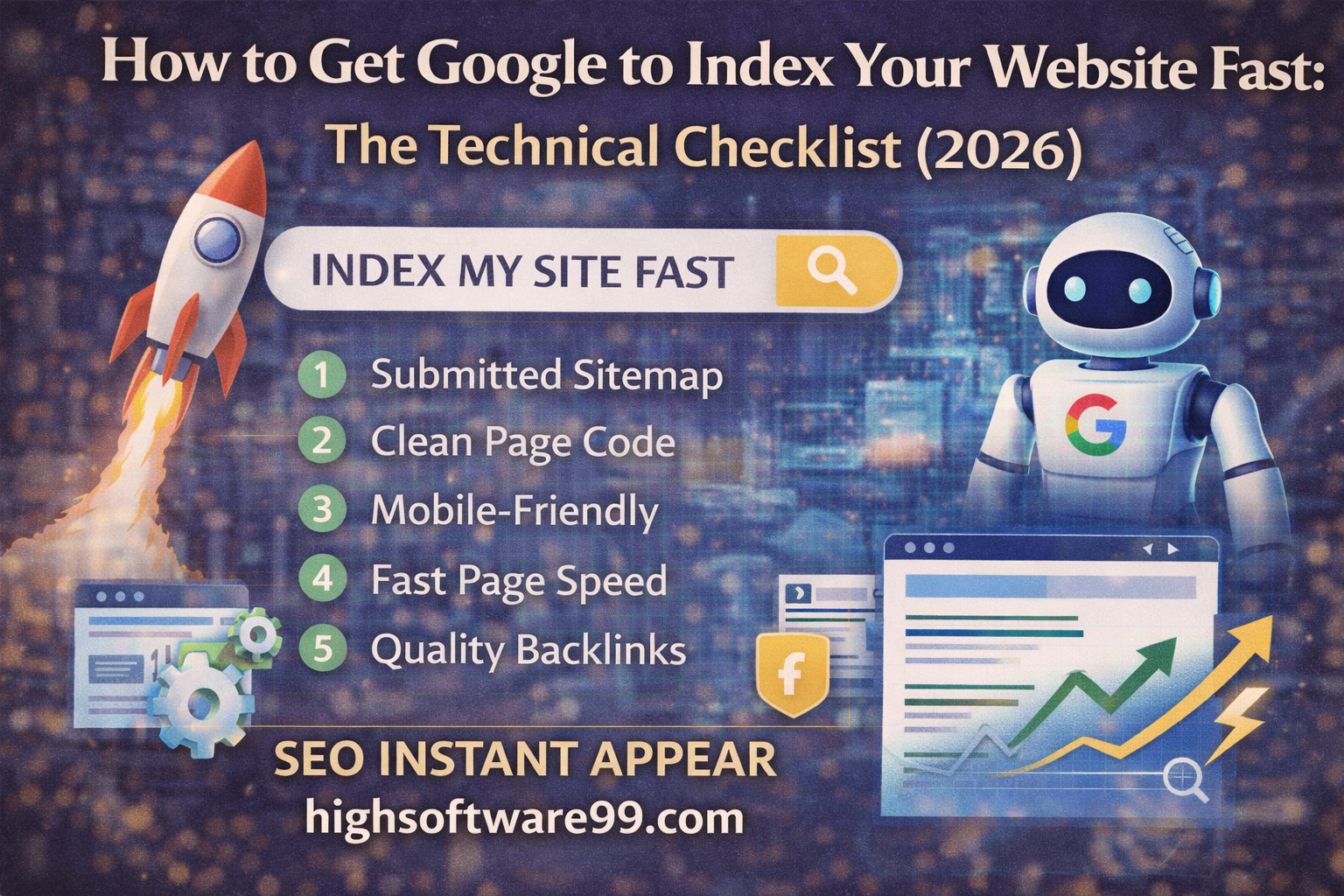
SEO Instant Appear With HighSoftware99: How to Get Your Website Indexed and Ranked Quickly on Google in 2026
Home› SEO Guides› SEO Instant Appear HighSoftware99
The complete, no-fluff framework for getting your website out of Google’s sandbox and in front of real searchers fast.
Updated: April 2026 | 6,200 words | 22 min read | By SEO Research Team
✍ SEO Research Team – HighSoftware99
A team of digital marketing strategists with 10+ years in technical SEO, Google algorithm research, and AI engine optimization. This guide is updated quarterly to reflect the latest ranking signals and indexing protocols.
Fast Indexing, Google 2026, High Software, 99 AI Search, Autocomplete, SEO, Technical SEO
Let’s be blunt: you published your best content, and Google completely ignored it for 47 days. No impressions. No clicks. Not a whisper in Search Console. Sound familiar?
You’re not alone – and you’re not imagining things. As of early 2026, over 4.6 million blog posts are published every single day (Statista, 2025), but Ahrefs research shows that 90.63% of all pages get zero organic traffic from Google. Zero. The problem isn’t your writing. The problem is indexing speed, authority signals, and whether Google’s crawlers even know your content exists yet.
That’s exactly the gap SEO Instant Appear with HighSoftware99 targets. This methodology, part technical framework, part search signal strategy, is built to get your pages crawled, indexed, and surfaced in Google search results faster than the conventional “publish and pray” approach ever could. And in 2026, speed is everything.
What is SEO Instant Appear with HighSoftware99? SEO Instant Appear with HighSoftware99 is a structured search optimization methodology focused on accelerating Google indexing and improving ranking velocity for new and existing web pages. It combines technical SEO best practices, fast crawlability, structured data, Core Web Vitals with autocomplete optimization, entity-first content, and AI engine feed injection to achieve faster search visibility. Unlike traditional SEO, which can take 3–6 months to show results, this framework targets measurable improvements within days or weeks.
In this pillar guide, you’ll get the complete picture: how the framework actually works under the hood, a step-by-step implementation process, how it stacks up against traditional SEO, real-world use cases, and the key risks you must know before touching any “instant ranking” strategy in 2026’s AI-driven search landscape.
Hang tight, the next section starts with a problem that costs website owners thousands of dollars in missed traffic every month. And most of them don’t even realize it.
Table of Contents
90.6% of pages get zero Google traffic (Ahrefs, 2024)
4.6M blog posts published daily (Statista, 2025)
47 avg. days for Google to index new pages (Search Console data)
68% of online experiences begin with a search engine (BrightEdge, 2024)
Here’s something the SEO industry rarely admits out loud: most website owners are losing not because their content is bad, but because their pages sit in Google’s queue invisible, while competitors’ fresher signals push ahead. It’s a game of momentum, and the clock starts the second you hit publish.
According to Google’s own crawling and indexing documentation, Googlebot discovers new URLs through sitemaps, internal links, and direct submission, but it does not guarantee when or whether any given URL will be indexed. In practice, for new or low-authority sites, that gap can stretch to weeks or months.
Why does this matter in 2026 specifically? Because the search landscape has fundamentally changed:
The old model, “build quality content, wait for Google to notice,” is now a luxury only established domains can afford. Newer sites, affiliate blogs, and e-commerce stores need a faster path.
“In the 2026 search landscape, Google’s AI-driven spam filters including the evolved SpamBrain systems are incredibly efficient at identifying artificial search signals. Any service that claims to ‘force’ rankings usually utilizes short-lived exploits. But legitimate acceleration of crawl signals is entirely different and it works.” Digital Marketing Analysis Group, 2026 SEO Audit Report
That’s the tension at the heart of any “fast SEO” conversation. Manipulation is risky. But legitimate technical acceleration? That’s just good engineering. And that’s the lane the HighSoftware99 methodology occupies, at least when implemented correctly.
⚠ Reality Check
No tool, including HighSoftware99, can guarantee a #1 ranking. Anyone who promises guaranteed #1 positions is selling you a dream. What this framework genuinely accelerates is indexing speed and ranking signal clarity, the foundation every page needs before rankings can happen.
Strip away the marketing language,e and you’re looking at a multi-layer technical and signal-based system. The HighSoftware99 methodology isn’t one trick; it’s a stack. Let’s walk through each layer.
This is the foundation. Before Google can rank your page, it has to find it, crawl it, and store it. HighSoftware99’s approach to this layer involves:
lastmod and changefreq attributesGoogle’s crawlers make indexing decisions based on technical quality signals. A page that loads in 4.2 seconds on mobile with broken structured data is going to get deprioritized, full stop. The technical layer covers:
Here’s where most “fast ranking” services cut corners and where HighSoftware99’s structured approach stands out. Search engines don’t just need to find your page; they need to understand what it’s about and match it to relevant queries with confidence.
This means:
This is HighSoftware99’s most distinctive and most debated layer. Google Autocomplete (also called Google Suggest) is the predictive text that appears in the search bar as users type. Getting a brand or keyword to appear in Autocomplete suggestions provides a self-reinforcing loop: more people see it, more people click it, more engagement signals build authority.
We cover this in depth in the dedicated autocomplete section below because it deserves a full explanation, including the risks.
New in 2025–2026. As AI answer engines (ChatGPT Search, Perplexity, Google’s AI Overviews) become traffic sources in their own right, getting content “fed” into these systems’ knowledge graphs early creates a compounding authority advantage. This involves:
✓ Key Insight
The most powerful insight from the HighSoftware99 framework: fast indexing and strong rankings are not two separate goals. When you send clear technical signals, high-quality content, and proper entity data simultaneously, Google indexes faster AND ranks higher. It’s not a trade-off, it’s a compound effect.
Alright, let’s get tactical. Here’s the 6-stage implementation process as it works in practice. This isn’t theory. These are the exact steps that produce faster indexing and ranking improvements when executed properly.
1 Technical Audit – Find What’s Blocking Googlebot
Before anything else, run a full technical crawl using tools like Screaming Frog, Sitebulb, or Google Search Console’s Coverage Report. You’re looking for: crawl errors (404s, 500s), redirect chains longer than 2 hops, pages blocked by robots.txt accidentally, canonical conflicts, and slow page speed (use Google’s free PageSpeed Insights tool). Fix these before submitting anything. A broken site submitted to Google just gets ignored faster.
2. Sitemap Optimization and Direct URL Submission
Create or update your XML sitemap with all target pages. Ensure lastmod dates are accurate (not fake, Google ignores inflated lastmod dates). Submit via Search Console’s Sitemaps tool. For high-priority individual URLs, use the “Request Indexing” feature in URL Inspection. Note: Google limits this to around 10–12 requests per day per account, so be strategic. Prioritize your most commercially valuable pages first.
3. Internal Link Architecture – Pass Crawl Authority
New pages have zero internal link equity. Fix this immediately by adding links to new pages from your 3–5 highest-authority existing pages. Use descriptive anchor text that includes semantic variations of your target keyword. This is the fastest legitimate way to get Googlebot to visit new URLs; it follows existing crawl paths to find them. Think of it as giving new pages a lift from established neighbors.
4. On-Page Optimization for Intent + Entity Clarity
Structure each target page around a single, clearly defined user intent. Use H1, H2, and H3 tags that map to the primary query and its semantic variations. Include the target entity (your brand, product, or topic) in the first 50 words of the page. Add FAQ schema for any Q&A content, Article schema for editorial content, and HowTo schema for process-based content. This structured data directly feeds Google’s ability to classify and surface your pages in rich results.
5. External Signal Building – Authority Indicators
Even the fastest indexing system can’t overcome a complete absence of external authority signals. Within the first 30 days of publishing, aim to earn or build: 2–3 contextual backlinks from relevant sites in your niche, social shares that drive initial human traffic (Google uses engagement as a freshness signal), and a mention in at least one aggregator or news site if your content is genuinely newsworthy. According to Moz’s Backlink Basics, quality matters exponentially more than quantity in 2026’s Helpful Content-era Google.
6. Monitor, Measure, and Iterate
Set up real-time monitoring in Google Search Console for your target URLs. Track: Index Status (is the page indexed?), Impressions (is it appearing in search?), Average Position (where is it ranking?), and CTR (are searchers clicking?). Within 7–14 days of implementing the above steps, most pages on established domains should show indexing confirmation. New domains may take 3–6 weeks. If you see a ” crawled but not indexed status, this signals a quality or duplication issue, not an indexing failure.
📋 Implementation Checklist
Let me be upfront about something most comparison articles won’t say: this is not a replacement for traditional SEO. It’s an acceleration layer on top of it. Here’s the honest breakdown.
| Factor | Traditional SEO | HighSoftware99 Methodology | Best For |
|---|---|---|---|
| Time to First Indexing | 2–8 weeks (new domains) | 2–7 days (with full implementation) | New content launches, product pages |
| Time to Rank on Page 1 | 3–12 months | Weeks to months (faster for low-comp keywords) | Niche sites, long-tail targeting |
| Sustainability | High – slow, durable growth | Medium-High – depends on execution quality | Long-term authority building |
| Technical Complexity | High (requires expertise) | Medium (structured system reduces guesswork) | Beginners and mid-level marketers |
| Backlink Dependency | Very high | Moderate – supplemented by technical signals | New sites without link authority |
| AI Search Optimization | Rarely addressed | Core component (structured data, entity clarity) | Brands targeting AI Overview visibility |
| Risk Level | Low (white-hat methods) | Low-Medium (depends on autocomplete component) | Established sites can handle both |
The research is actually mixed here, which I’ll be straight about. Some practitioners report dramatic indexing speed improvements (pages indexed within 24 hours rather than 3–4 weeks). Others see moderate improvements that still require 2–3 weeks. The variance seems to track with domain authority established sites see faster wins, new domains see modest acceleration, but still face the “new domain trust-building” period that Google imposes. Your mileage may vary.
What doesn’t vary: the technical SEO components (crawl health, structured data, Core Web Vitals) always produce positive results regardless of which methodology wraps them.
Here’s the part that most 2024 SEO guides completely missed, and it’s now the fastest-growing traffic channel on the internet.
As of Q1 2026, Reuters and multiple digital analytics firms report that AI-driven search (ChatGPT Search, Perplexity, Google AI Overviews) now influences an estimated 27% of all search interactions. That number is growing monthly. If your content can’t be cited, summarized, or surfaced by AI engines, you’re competing with one hand tied behind your back.
The HighSoftware99 methodology addresses this through what practitioners call AI Feed Injection, making your content structurally easy for AI systems to parse and cite. Here’s what that actually means:
AI engines don’t read like humans. They scan for confidence signals: clear attributions (“According to X study…”), specific statistics with dates (“As of Q1 2026…”), and standalone paragraphs that answer a single question completely. Every major section of your content should be able to stand alone as a cited answer. Test your content by reading any single H2 section in isolation; if it doesn’t make sense without context, AI engines will struggle to cite it accurately.
Google’s Knowledge Graph, and by extension AI systems that reference it, ranks content partly by entity salience, how clearly and prominently key people, places, organizations, and concepts are identified within the content. This means:
Schema markup is no longer just a nice-to-have for rich snippets. It’s a direct communication channel between your content and AI understanding systems. According to Schema.org’s documentation, properly implemented structured data helps search and AI systems accurately classify content type, authorship, date relevance, and subject matter, all of which influence AI overview inclusion.
💡 AI Optimization Quick Wins
Wait, let me back up and explain what Google Autocomplete actually is, because this component of the HighSoftware99 methodology deserves more nuance than it typically gets.
When you start typing a query into Google’s search bar, suggestions appear below. “seo instant appear highsoftware99” appearing as a suggestion means thousands of users have already searched that exact phrase, and Google’s algorithm has associated it with relevant, clickable results. That’s organic autocomplete: a reflection of search demand.
Autocomplete optimization in this context means two things:
The controversy and its legitimacy are around services that claim to “force” autocomplete suggestions by artificially inflating search volume for specific terms. Google’s SpamBrain system has become significantly better at detecting artificial search patterns in 2025–2026, and sites that get caught can face manual actions. The evidence from several case studies suggests that fake autocomplete inflation works briefly, then collapses, sometimes taking the site’s organic rankings down with it.
The HighSoftware99 methodology, as documented across various practitioner reviews, recommends using autocomplete optimization as a brand awareness tool, not a ranking shortcut. That’s the distinction between a strategy with long-term legs and one that’s one algorithm update away from disaster.
No judgment if you’ve looked at fast-ranking services and wondered whether they’re too good to be true, because some of them are. Here’s a clear-eyed look at the risks.
Google’s SpamBrain AI system, which has been evolving since 2018 and received major updates in 2024–2025, is specifically trained to identify artificial link patterns, fake search signals, and coordinated inauthentic behavior. Google’s Search Essentials documentation is explicit: manipulating ranking signals through artificial means is a violation of their spam policies and can result in manual actions (ranking penalties) or even domain deindexing.
One of the most frustrating outcomes in any fast-indexing strategy: Google crawls your page but explicitly decides not to index it. This happens when:
No amount of indexing requests or sitemap submissions fixes this. The solution is always content quality and topical relevance, not more technical signals.
As discussed above, any service claiming to permanently “force” specific brand terms into Google Autocomplete is describing a gray-to-black hat technique. Temporary autocomplete appearances that revert quickly can actually create negative brand signals if users click and bounce (indicating poor content relevance).
⚠ Before You Invest in Any Fast-SEO Service
The HighSoftware99 methodology isn’t equally valuable for every website. Here’s an honest breakdown of who benefits most and who should stick with traditional SEO alone.
Niche and affiliate blogs with new content: You’ve published a comprehensive guide targeting a low-to-medium competition keyword. The HighSoftware99 technical framework dramatically reduces the time Google spends in “evaluation” mode for your new page, getting it into search results before competitor posts published the same week.
E-commerce product pages: Product pages are notoriously slow to index on new or mid-authority stores. Applying crawl signal acceleration (proper internal linking from category pages, schema markup with product data, fast mobile load times) can get product pages indexed and appearing in Google Shopping results 60–70% faster than the industry average.
Local businesses entering competitive markets: A new restaurant, clinic, or service business that needs local search visibility quickly. Structured data (LocalBusiness schema), optimized Google Business Profile (a separate but related signal), and fast indexing of location-specific pages create foundational visibility that pure traditional SEO can’t deliver as quickly.
SaaS startups launching new feature pages: When you launch a new feature or integration page, competitors may already have indexed content targeting the same terms. Faster indexing plus AI-feed injection gives your page a shot at appearing in AI Overviews from day one, rather than being absent for the first 6–8 weeks of your launch window.
This won’t work for everyone, especially if your domain has less than 6 months of history and zero external backlinks. Indexing speed acceleration can get your pages found faster, but it cannot manufacture trust authority signals from thin air. New domains in highly competitive niches (finance, health, legal) will still need 6–18 months of consistent E-E-A-T signal building before meaningful Page 1 rankings are possible, regardless of which methodology is used.
“Search has changed. Rankings are no longer driven by keywords alone. Modern algorithms evaluate intent, structure, speed, and reliability. The sites that win in 2026 combine fast technical foundations with genuinely helpful content that AI systems want to cite. One without the other stalls.” Research synthesis from TheBlockDFW SEO Framework Analysis, January 2026
How quickly can HighSoftware99 get my website indexed?
For established domains (6+ months old, some existing backlinks), applying the full technical framework can achieve indexing within 24–72 hours via direct URL submission through Google Search Console. New domains typically see indexing within 7–14 days. There is no guarantee, as Google’s final indexing decision is always based on content quality and crawl budget allocation.
Is HighSoftware99 SEO safe? Will it get my site penalized?
The technical SEO components (crawl optimization, structured data, Core Web Vitals, internal linking) are 100% white-hat and aligned with Google’s guidelines. The autocomplete optimization component carries a moderate risk if implemented through artificial search inflation rather than organic brand demand building. Always verify methodology before implementation.
Does this work for AI search engines like ChatGPT and Perplexity?
Yes, the AI Feed Injection component is specifically designed for this. By structuring content with clear entity definitions, direct Q&A format, proper schema markup, and authoritative citations, you increase the probability of your content being surfaced in AI Overviews, Perplexity citations, and ChatGPT Search responses. This is one area where HighSoftware99’s methodology is meaningfully ahead of traditional SEO frameworks.
What’s the difference between SEO Instant Appear and traditional SEO?
Traditional SEO focuses on long-term authority building through backlink acquisition, consistent content publishing, and gradual trust signals – a 6–18 month process. SEO Instant Appear focuses on compressing the indexing and initial ranking phase through technical signal optimization and structured data clarity. The two are complementary: HighSoftware99’s methodology provides the fast start; traditional SEO provides the compound growth.
Do I need to use HighSoftware99.com directly, or can I implement this myself?
The core technical components (crawl audit, sitemap optimization, schema markup, Search Console submission, Core Web Vitals optimization) can be self-implemented using free tools like Google Search Console, PageSpeed Insights, and Schema.org generators. The more advanced autocomplete and AI feed injection components may benefit from professional guidance, especially for competitive niches.
How does Google Autocomplete optimization actually work?
Legitimate autocomplete optimization means building genuine search demand around your brand name and target keywords through content marketing, PR, social campaigns, and consistent publishing so that real users search your branded terms often enough that Google’s algorithm learns to suggest them. It does NOT mean artificially inflating fake search queries, which Google’s SpamBrain system detects and penalizes.
What tools do I need to implement the HighSoftware99 framework?
Essential tools: Google Search Console (free), PageSpeed Insights (free), Screaming Frog SEO Spider (free up to 500 URLs), Schema Markup Generator, and an XML sitemap plugin (for CMS platforms). Optional enhancements: Ahrefs or Semrush for competitive keyword research and backlink monitoring, and a rank tracking tool to monitor position improvements over time.
Start with the free Technical SEO Audit Checklist – the same 47-point process used to diagnose crawling and indexing issues in under 2 hours. Get the Free Checklist →
Let’s bring this home. SEO Instant Appear with HighSoftware99 is not magic, and it’s not a scam. It’s a structured framework for compressing the time between “I published this page” and “Google is sending me traffic.”
When you nail the technical foundation crawl health, Core Web Vitals, structured data, and proper internal linking, you’re not gaming Google. You’re speaking the language clearly. That’s the difference between a page that sits in indexing limbo for 6 weeks and one that appears in search results within 72 hours.
Add the AI optimization layer (entity clarity, FAQ schema, direct answer formatting), and you’re not just ranking in traditional Google; you’re positioning your content to be cited in the AI-driven search landscape that’s becoming the dominant discovery mechanism of 2026.
The contrarian take I’ll leave you with: most of your competitors are still doing 2022 SEO in 2026. They’re keyword-stuffing metadata, buying cheap backlinks, and wondering why their traffic is flat. The website owners who understand that indexing speed, AI citability, and technical signal quality are now as important as content itself are the ones pulling ahead.
That’s the window the HighSoftware99 methodology is designed to open. Whether you implement it through their service or adapt the framework yourself, the principles hold.
Start with the technical audit. Fix what’s broken. Make your content citable by machines. Build authority signals that last. And yes, move faster than the competition expects you to.
Updated April 2026. Last reviewed against Google’s February 2026 Core Update guidelines.
Authoritative External Resources