 111
111 2
2 3
3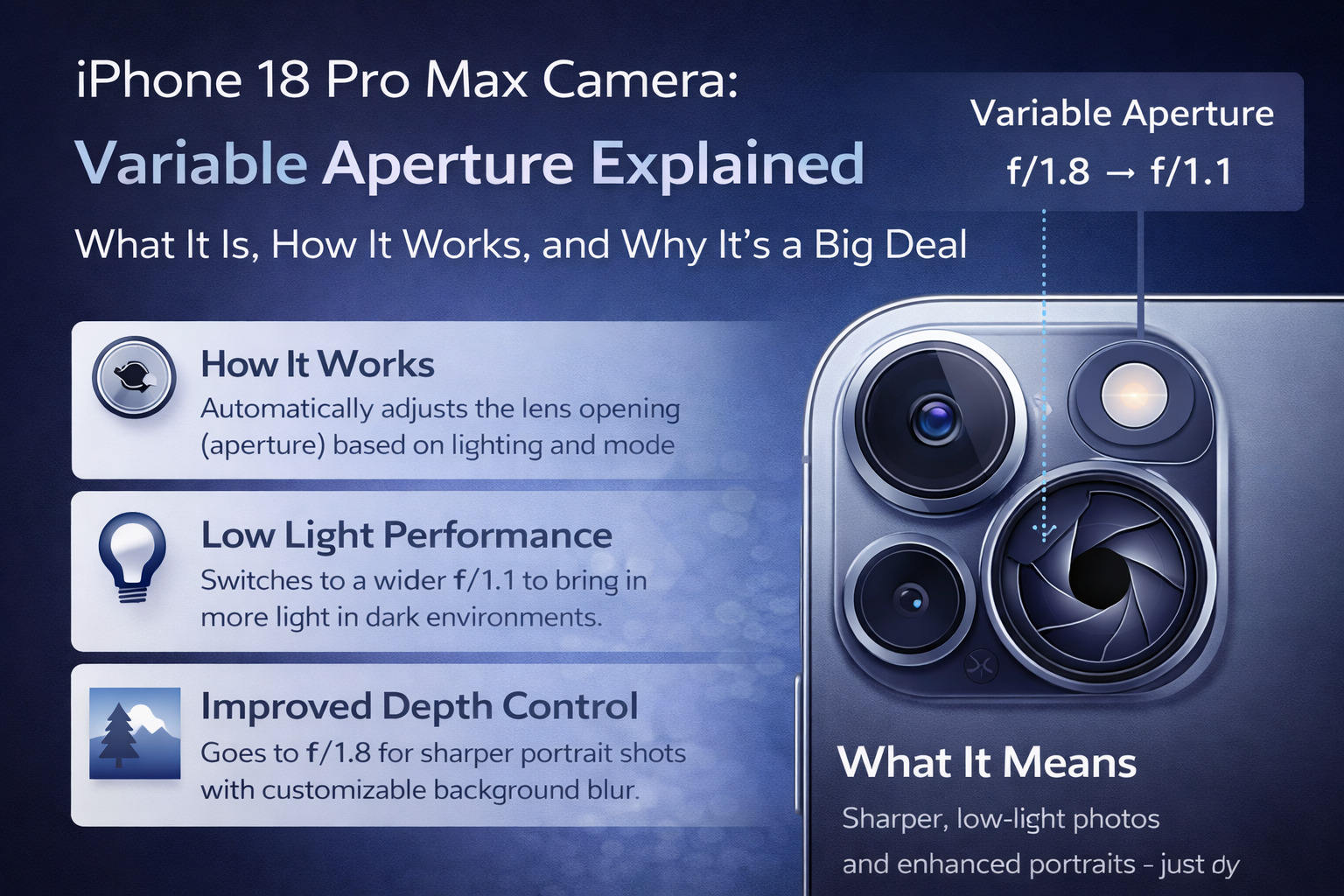
By Admin | Updated April 2026 | Related: iPhone 18 Pro Max: Full Release Date, Price & Specs Guide
If you’ve seen “variable aperture” in iPhone 18 Pro Max leaks and thought “sounds technical, probably won’t matter to me,” stick around. Because this is the feature that photographers have been asking Apple for since the camera plateau first appeared on the iPhone 15 Pro.
And it’s finally, apparently, happening.
Variable aperture on a smartphone camera isn’t a software trick or a computational photography workaround. It’s a physical mechanism inside the lens,s one that changes how much light reaches the sensor by adjusting the size of the opening. DSLR cameras have had it forever. Samsung experimented with it in its Galaxy S9 back in 2018. Apple has never done it.
Until, if the leaks are right, September 2026.
Variable aperture is a camera feature that allows the lens opening (the aperture) to mechanically change size, giving the photographer control over two things simultaneously: how much light enters the lens, and how much of the scene is in sharp focus (depth of field).
On every iPhone before the 18 Pro Max, the main camera has a fixed aperture. The iPhone 17 Pro Max’s main lens is fixed at f/1.78. That number never changes; the hardware is locked. The camera compensates for different lighting conditions entirely through software: faster or slower shutter speeds, higher or lower ISO, and computational processing like Deep Fusion and Photonic Engine.
Variable aperture changes that equation at the hardware level.
If you’re not familiar with aperture numbers, here’s the fastest possible explanation:
Current iPhones are always at f/1.78 on the main lens. That’s great for low light. But in bright sunlight, it causes overexposure that the camera has to compensate for electronically, and there are limits to how elegantly that can be done. Landscape photographers often want f/8 or f/11 for tack-sharp focus from foreground to horizon. iPhone can’t do that. Right now.
Variable aperture reportedly allowing the iPhone 18 Pro Max main lens to shift between approximately f/1.6 and f/2.8, based on early speculation,n wouldn’t be the full range of a DSLR, but it would give you two meaningfully different tools in one camera.
Here’s where the variable aperture story gets really interesting for non-photographers.
The iPhone 17 Pro Max is an incredible video camera. But it has one persistent limitation that professional videographers know well: exposure breathing during transitions.
Picture this: you’re filming a wedding video, walking from a candlelit ballroom into a sunny garden. The iPhone’s aperture is fixed. As ambient light changes dramatically, the camera has to compensate fast, st and even with computational processing, you often get a brief flickering brightness shift as the sensor adjusts. It’s subtle. But in professional footage, it’s noticeable.
A mechanical aperture compensates for that in real time, the way a cinema camera does. For anyone making YouTube videos, Instagram Reels, or short films on an iPhone, this is the biggest upgrade in years.
That analysis isn’t overblown. It’s how cinema cameras have handled this problem for decades: rather than adjusting electronically, they adjust optically. The image quality difference in smooth, professional footage is real.
The practical video impact:
There’s a secondary camera development that’s received less attention but could matter as much as the variable aperture mechanism itself.
Apple is reportedly partnering with Samsung to develop new camera sensor technology at its Austin, Texas facility, which would mark the first time Apple has used Samsung camera hardware in iPhones, ending over a decade of Sony’s exclusive hold on Apple’s camera supply chain.
Sony sensors in iPhones have been excellent. The iPhone 17 Pro Max’s camera system is widely regarded as best-in-class or very close to it in mobile photography. So why would Apple turn to Samsung?
The answer is probably: sensor size and dynamic range. Samsung’s own Galaxy S series has long been praised for the color rendering and highlight recovery in its camera areas, where the iPhone has historically been strong on detail but occasionally weaker on color accuracy in complex lighting. Apple bringing Samsung sensor expertise into its supply chain doesn’t mean the iPhone starts looking like a Galaxy camera. It means Apple has access to a different sensor architecture that its own camera teams can tune.
Caveat: this remains a rumor from supply chain analysts, not a confirmed Apple announcement. But the sources pointing to it are reliable enough to mention here.
Some tech writers have framed variable aperture as “Apple finally catching up to what software was already doing.” That’s not quite right, and it undersells what’s changing.
Computational photography (Deep Fusion, Photonic Engine, Portrait Mode processing) works after light hits the sensor. It takes the information the sensor captured and processes it intelligently: removing noise, sharpening edges, and simulating depth of field through machine learning.
Variable aperture changes what hits the sensor in the first place. It’s upstream of computational processing.
The combination is what gets interesting: a physically wider aperture in low light gives the sensor better raw data, and then Apple’s computational pipeline processes that already-better data. A physically narrower aperture in bright sunlight reduces overblown highlights before computational algorithms even touch the image.
It’s additive, not substitutive. The A20 Pro chip’s more powerful Neural Engine and the variable aperture lens work together hardware and software as genuine partners rather than software compensating for hardware limitations.
Based on current leaks and analyst reports for the iPhone 18 Pro Max camera system:
Rear Triple Camera Array:
| Lens | Sensor | Aperture | Key Feature |
|---|---|---|---|
| Main | 48MP | Variable (f/1.6–f/2.8 est.) | First variable aperture on any iPhone |
| Ultrawide | 48MP | Fixed | Improved low-light performance |
| Periscope Telephoto | 12MP | ~f/2.8 | 5x optical zoom |
Front Camera:
Video Capabilities:
It’s worth being honest here. This isn’t entirely new territory for the smartphone industry.
Samsung included a dual-aperture system in the Galaxy S9 (2018) specifically on the main camera, which could switch between f/1.5 and f/2.4. Users and reviewers were somewhat mixed on how noticeable the practical difference was in everyday shooting, though low-light improvements were measurable.
Samsung later dropped the variable aperture feature in subsequent Galaxy S models, moving toward larger sensor sizes and improved computational processing instead. Make of that what you will.
Apple’s implementation is expected to be more sophisticated than Samsung’s S9 approach, potentially a continuously variable mechanism rather than a two-position switch, and deeply integrated with Apple’s computational photography pipeline in ways that Samsung’s more hardware-siloed approach wasn’t.
Apple also has a different advantage: end-to-end control of hardware and software in a way Android manufacturers building on Qualcomm chips simply don’t have. When Apple designs the A20 Pro’s Neural Engine,e knowing the camera’s aperture range, the optimization possibilities are broader than a phone where camera hardware and processor come from different vendors.
Not everyone needs this. Let’s be honest about that.
You’ll notice the difference if youFilming
You might not care as much if you:
Apple’s camera presentations have become increasingly sophisticated over the recent product cycle,s not just showing sample photos, but demonstrating the computational pipeline, the sensor architecture, and the real-world filmmaker and photographer workflow.
Expect the variable aperture demonstration to be a centerpiece of the September 2026 event. Apple will likely show a side-by-side comparison of fixed versus variable aperture video in challenging lightlights’sIt’sind of visual proof that plays well on a large screen in an event keynote.
What to watch for in post-announcement reviews:
The answers come in September. Until then, the engineering logic behind variable aperture makes it the most consequential camera advancement Apple has announced for iPhone in years. Whether the real-world implementation lives up to the pre-launch promise is the question we’ll all be answering together.
What is variable aperture on the iPhone 18 Pro Max? Variable aperture is a mechanical camera feature that allows the lens opening to physically adjust in size. On the iPhone 18 Pro Max, the main 48MP camera is expected to include this feature for the first time on any iPhone, allowing greater control over light intake and depth of field than any previous iPhone camera.
How is variable aperture different from Portrait Mode? Portrait Mode simulates depth of field using software and AI. Variable aperture changes the depth of field optically before any software processing happens. Variable aperture produces actual optical blur and real light control; Portrait Mode mimics these effects computationally.
Did Samsung have variable aperture on its phones? Yes. Samsung included dual-aperture technology in the Galaxy S9 (2018), switching between f/1.5 and f/2.4. Samsung later discontinued the feature in favor of larger sensor sizes and computational photography. Apple’s expected implementation is expected to be more refined and better integrated with its chip architecture.
What camera sensors will the iPhone 18 Pro Max use? Current leaks suggest Apple may be using Samsung-developed camera sensor technology for the first time, moving away from its decade-long exclusive use of Sony sensors. This remains unconfirmed pending the official September 2026 announcement.
Will the iPhone 18 Pro Max shoot 8K video? Multiple leaks suggest 8K video recording at 60fps, along with ProRes Log format and Apple Vision Pro spatial video optimization. These features are expected across the iPhone 18 Pro lineup, not exclusively the Pro Max.
What is the front camera resolution on the iPhone 18 Pro Max? The front camera is expected to upgrade to 24MP, up from 18MP in the iPhone 17 lineup. This would improve selfie quality, FaceTime clarity, and video call performance in lower light.