 111
111 2
2 3
3
By a financial technology analyst tracking semiconductor stocks and NAND flash memory markets.
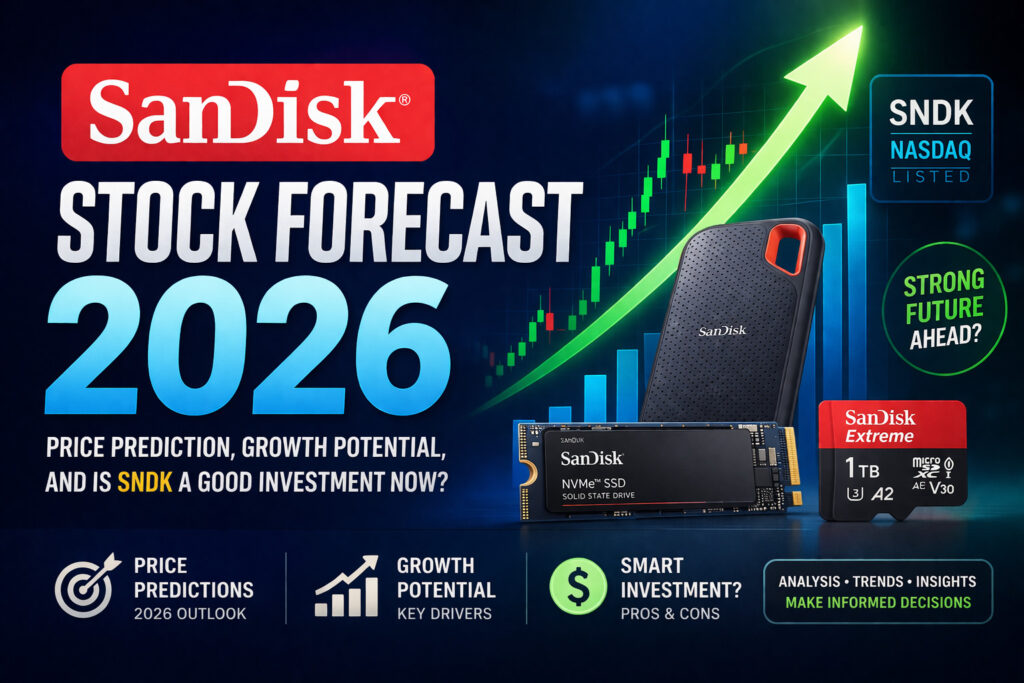
Ever watch a stock go up 1,000% in a single year and wonder if you missed the boat or if it’s still early? That’s exactly the question swirling around SanDisk Corporation (NASDAQ: SNDK) right now, as we move deeper into 2026.
Here’s the thing: SanDisk’s comeback story isn’t just about stock price fireworks. It’s about a company that shed dead weight, found itself at the exact center of the AI infrastructure buildout, and now operates in one of the most supply-constrained memory markets in modern history. When you understand why the stock has done what it’s done, the question of where it goes next gets a lot more interesting.
In this pillar guide, we’ll walk through everything: the spinoff that changed everything, the AI-driven NAND supercycle, price targets from Wall Street’s top analysts, the real risks most bulls ignore, and whether SNDK makes sense in a portfolio today. Whether you’re a long-term growth investor, a momentum trader, or just trying to understand what all the noise is about, this is the deep dive you need.
SanDisk Corporation is a pure-play NAND flash memory company headquartered in Milpitas, California, trading on the Nasdaq under the ticker symbol SNDK. It designs and manufactures NAND flash storage products, the technology powering SSDs in data centers, smartphones, and AI infrastructure worldwide. Through its longstanding joint venture (JV) with Japan’s Kioxia (formerly Toshiba Memory), SanDisk is one of only a handful of companies capable of producing NAND flash at a global scale, making it a structural oligopolist in a market facing unprecedented demand.
The company completed its separation from Western Digital Corporation (WDC) on February 24, 2025, officially relisting on Nasdaq that same day. Since then, SNDK has transformed from a conglomerate subsidiary into the semiconductor sector’s most talked-about pure-play AI storage company. As of April 2026, the stock trades around $788, having surged more than 1,300% from its first-day price near $48.60, one of the most dramatic post-spinoff rallies in recent memory.
Let’s back up, because the backstory is important here.
For years, Western Digital operated two fundamentally different businesses under one roof: hard disk drives (HDDs) and NAND flash memory. The HDD side is a slow-growth, commodity-like business serving the enterprise storage market. The NAND flash side is a high-volatility, high-upside technology business tied to consumer electronics, smartphones, and increasingly AI infrastructure.
The problem? Investors hated the mismatch. Wall Street couldn’t decide how to value a company that was simultaneously a boring HDD supplier and a cutting-edge semiconductor maker. The sum-of-parts discount was enormous. Financial discipline in one division often got sacrificed for capital needs in the other.
The solution was separation, and it worked beyond almost anyone’s expectations.
SanDisk celebrated its Nasdaq listing in February 2025 after completing its separation from Western Digital, positioning itself as a global flash and advanced memory technology innovator under CEO David Goeckeler. Goeckeler, who led the spinoff, put it clearly at the time: NAND is an “incredible enabler” operating in strong and growing markets, and the new SanDisk was free to go all-in.
Plot twist: The spinoff’s timing was almost perfect. SanDisk launched as an independent company just as a global NAND shortage was beginning to bite.
Here’s something most cheerleaders won’t tell you: SanDisk’s first earnings report as a public company was rough. Revenues in the quarter ended March 28, 2025, were $1.7 billion, down 0.6% year-on-year and 10% sequentially, and after a $1.83 billion goodwill impairment charge, the company posted a GAAP loss of $103 million, contrasting with the year-ago $27 million profit.
But here’s the thing: impairment was a one-time accounting event, not a business deterioration. And Goeckeler was already taking action. He noted that ASPs had fallen “high-single digits” due to short-term oversupply and announced the company would be extending “fab underutilization actions until supply and demand are balanced.” Translation: SanDisk deliberately cut production to stabilize pricing, accepting short-term revenue pain for long-term margin power.
That discipline, something rare in the semiconductor industry, set the stage for everything that followed.
“I’m pleased with our team’s execution in the first quarter as a standalone company. We have taken actions to reduce supply to match demand and commenced price increases this quarter.” – David Goeckeler, CEO of SanDisk, May 2025
Ask anyone who covered the memory sector in 2023, and they’ll tell you it was ugly. Oversupply sent prices plummeting. Companies wrote down billions. The conventional wisdom was that NAND flash was a fundamentally cyclical business boom, bust, repeat, forever.
That narrative is getting challenged right now. Hard.
The reason is AI. But not in the vague, hand-wavy way “AI changes everything” gets thrown around. There’s a specific mechanism at work here.
Training large AI models and, increasingly, running inference on them at scale, requires storing and accessing massive amounts of data continuously. We’re talking about hyperscale data centers at Amazon, Google, and Microsoft that are essentially warehouses of compute and storage, processing exabytes of information around the clock. Rapid AI and cloud workload expansion are driving data center NAND exabyte growth at a pace well above overall supply, positioning enterprise SSD portfolios and deepening hyperscaler engagements to support sustained revenue acceleration and structurally higher pricing power.
Supply hasn’t kept up. After years of underinvestment in new fabrication plants during the 2023 downturn, the industry now faces a structural shortage, leading to triple-digit price increases for enterprise-grade flash memory over the last 18 months.
Sound familiar? You’ve probably seen this movie before in semiconductors, except this time, the demand driver isn’t a temporary trend. AI infrastructure isn’t being built to satisfy a passing trend. It’s being built because the world’s largest companies are making multi-decade bets on compute as the central factor of production.
Here’s where it gets more interesting. Most coverage of SanDisk focuses on data centers and rightfully so. But there’s a second demand wave forming at the “edge.”
As 2026 smartphone models from Apple and Samsung integrate local large language models, the baseline storage requirement for a standard phone is shifting significantly, creating a new cycle of device-level NAND demand independent of data center dynamics. Every smartphone that runs an on-device AI assistant needs more NAND flash than its predecessor. Multiply that by over a billion handset upgrades per year, and you have a demand tailwind that would exist even if hyperscaler spending plateaued.
This is the edge AI cycle, and it’s barely priced into most SNDK models.
Let’s look at what actually happened.
Since its day-one return to the market at approximately $48.60, SNDK has surged over 1,173%, fueled by insatiable global demand for AI-optimized storage. The company posted Q4 2025 EPS of $6.20, a record beat versus the $3.31 consensus estimate, with quarterly revenue of $3.03 billion, up 61.2% year-over-year, and inventory turnover improved to 4.2x as demand outstripped supply.
Let that Q4 2025 EPS beat sink in: analysts expected $3.31. SanDisk delivered $6.20. That’s not a beat, that’s a different ballgame.
For fiscal year 2025 (ending June), the company reported $7.4 billion in revenue, with gross margins expanding from 22% to 30.1% within a single year, driven by a global NAND shortage and the shift toward premium enterprise products.
SanDisk has been one of the market’s biggest success stories since splitting from Western Digital in February 2025, with revenue jumping 23% year-over-year to $2.3 billion in Q1, and adjusted EPS surging from $0.29 to $1.22 quarter-over-quarter. CEO David Goeckeler has explained that the industry learned painful lessons from the 2023 downturn, when oversupply destroyed billions in shareholder value.
Why does this matter for the 2026 price prediction? Because a company that consistently blows past earnings estimates by 80%+ tends to get re-rated by Wall Street. Analyst price targets chase fundamentals, and when fundamentals keep surprising to the upside, targets keep rising.
Let’s get into the actual numbers, because this is where it gets complicated.
The 16 analysts covering SanDisk stock have a consensus rating of “Buy” and an average 12-month price target of $555.13, though this figure is calculated from a range spanning from $50 to $900. That $50 low target is almost certainly stale, a holdover from before the AI re-rating. The more actionable data is at the high end.
TipRanks data shows SanDisk has a Strong Buy consensus from 11 buy ratings, 3 hold ratings, and 0 sell ratings among its tracked analysts, with an average 12-month price target of $809.29. Next quarter’s EPS estimate stands at $14.12, with a range from $13.00 to $17.00 compared to the previous quarter’s $6.20 EPS.
Individual notable analyst moves tell a more granular story:
The spread between Goldman’s $320 and Jefferies’ $1,000 target is a 3x difference from the same stock. That divergence tells you something important: SanDisk’s 2026 outcome depends heavily on which assumptions you make about the NAND cycle’s durability.
Base Case ($900–$1,200): ChatGPT’s AI-driven projection assigns a 60% probability to SNDK trading between $900 and $1,200 by year-end 2026, assuming continued earnings growth driven by AI demand with limited valuation expansion as the stock matures. This scenario requires continued earnings growth but no major acceleration from current levels.
Bull Case ($1,400–$1,800): A more bullish scenario sees the stock reaching $1,400 to $1,800 if AI demand accelerates, NAND pricing remains tight into late 2026, and institutional capital continues rotating into AI infrastructure with a 25% probability assigned to this outcome. This scenario would require both fundamental strength and multiple expansion.
Bear Case ($500–$700): The bear-case range of $500 to $700 reflects risks including a post-index-inclusion pullback, easing memory conditions, or a broader rotation away from high-valuation tech stocks carrying a 15% probability according to this model.
For a longer-term context, the memory market is expected to remain undersupplied through 2026, driven by production cuts and surging AI and data center demand, which gives SanDisk significant pricing power and has allowed for recent price hikes across its product lines.
Here’s a question most retail investors never ask: why can’t Samsung, SK Hynix, and Micron simply flood the market and destroy SanDisk’s pricing power?
Part of the answer is the Kioxia JV. SanDisk’s competitive edge lies in its joint venture with Kioxia, which provides a unique cost-sharing structure that rivals struggle to replicate, allowing the company to share the multi-billion-dollar costs of R&D and fabrication plants while maintaining a significant portion of global bit production.
But the deeper answer is technology leadership.
SanDisk’s current-generation BiCS8 represents 218-layer technology offering industry-leading density and power efficiency, while BiCS9 and BiCS10 (332-layer) production was announced ahead of schedule. In early 2026, SanDisk launched the world’s first 256TB enterprise SSD, designed for AI data lakes that allow data centers to consolidate dozens of server racks into a single unit, drastically reducing energy consumption and cooling costs.
256TB in a single drive. To put that in perspective: you could store the entire text of over 100 million books on a device the size of a paperback novel. That’s what AI data centers increasingly need, not just storage, but dense storage that reduces physical footprint and power draw.
This is where things get genuinely exciting and speculative.
CEO David Goeckeler has stated that High Bandwidth Flash (HBF) represents a new paradigm for AI inference, and a first 500-layer NAND architecture announcement with Kioxia is expected by late 2026. HBF bridges the speed gap between traditional NAND and expensive HBM (High Bandwidth Memory), and if it becomes the standard for AI inference, it could significantly expand SanDisk’s total addressable market.
HBF is essentially an attempt to create a new memory tier faster than current NAND, cheaper than DRAM, and purpose-built for AI workloads. If this technology lands commercially, SanDisk wouldn’t just be competing for storage contracts. It would be competing for compute infrastructure contracts in a much larger market.
I don’t have all the answers on whether HBF will succeed. The technology is genuinely novel, and execution risk is real. But it’s the kind of optionality that doesn’t show up in most DCF models.
The NAND market remains an oligopoly, but the dynamics have shifted. SNDK has significantly outperformed peers like Micron and Samsung, as investors view it as a pure play on the NAND recovery without the overhead of DRAM or logic manufacturing.
Let’s break down the competitive landscape:
Samsung Electronics is the global volume leader in NAND, but it’s a massive conglomerate spanning displays, consumer electronics, chips, and more. When you buy Samsung, you’re getting a diversified bet, not a concentrated NAND play.
SK Hynix is a formidable rival – it acquired Intel’s NAND business (now Solidigm) and is aggressively competing in the enterprise segment. SanDisk and SK Hynix are currently neck-and-neck in the race for high-capacity enterprise market share.
Micron Technology competes in both DRAM and NAND and has been aggressive in HBM (High Bandwidth Memory) for AI. Micron’s diversification is both a strength and a dilution of NAND upside exposure.
SanDisk’s positioning: It’s the only major public company that is exclusively NAND flash. Every dollar of enterprise AI storage demand flows through NAND, and SNDK captures 100% of that exposure without DRAM noise or legacy consumer electronics overhead.
That’s the pure-play premium. Whether the premium is fair at $788/share depends on your conviction about the NAND cycle’s duration.
Honesty matters here. The case against SNDK is real, even if it’s been losing money for the past 12 months.
Risk #1: NAND Cyclicality
Despite current euphoria, the memory market is notoriously boom-or-bust, and any slowdown in AI spending could lead to an inventory glut and a rapid collapse in margins. The 2023 downturn wiped out billions in shareholder value across the sector in less than 18 months. Anyone claiming the cycle is permanently broken hasn’t lived through enough cycles.
Risk #2: Technology Execution
Skipping generations like the rush to BiCS10 carries the risk of manufacturing defects or lower yields, which could erode margins. Semiconductor manufacturing at the bleeding edge is extraordinarily difficult. A single yield problem at the Yokkaichi fab could send margins backward quickly.
Risk #3: Geopolitical Exposure
SanDisk’s joint venture with Kioxia relies on facilities in Japan, and much of its assembly takes place in Asia. Any escalation in regional tensions could disrupt its global supply chain. Export controls are already limiting sales of high-end AI storage to China, a meaningful market that’s now largely off the table.
Risk #4: AI Efficiency Algorithms
Alphabet’s TurboQuant tool has raised near-term demand concerns by improving model efficiency, though analysts broadly argue efficiency gains expand AI use cases rather than reduce total memory demand. This is the “Jevons Paradox” debate for AI storage: does more efficient AI reduce storage needs, or does it enable more AI applications that create even greater demand? History suggests the latter, but it’s not guaranteed.
Risk #5: Valuation After a 1,300% Run
The research is actually mixed here. At $788/share with a consensus target of $809, SNDK is essentially trading at the average analyst target. That doesn’t mean it’s overvalued; targets get revised continuously, but it does mean further upside requires either target upgrades or fundamental outperformance. There’s less margin for error at these prices than there was 12 months ago.
Your mileage may vary on how you weigh these risks. But ignoring them entirely because the stock has gone up a lot is exactly the kind of reasoning that burns investors at cycle peaks.
Let me be clear: I’m not a licensed financial advisor, and nothing here is investment advice. But here’s how a thoughtful analyst might think through the decision.
For long-term growth investors who believe AI infrastructure spending is a multi-year secular trend (and specifically that storage demand will grow faster than supply capacity), SNDK offers unmatched pure-play exposure. CFO Luis Visoso has stated that the NAND market is undergoing a structural evolution catalyzed by AI that should reduce cyclicality and support higher long-term margins, and management has indicated that customer demand is expected to exceed supply well beyond calendar year 2026.
For momentum investors, the near-term picture is more mixed. The stock is up 1,300% in 14 months. It’s just joined the Nasdaq-100. Nasdaq-100 inclusion is typically a one-off liquidity event, often priced in early and followed by higher volatility, making long-term performance more dependent on earnings growth tied to AI infrastructure demand and memory pricing than on index membership. Post-inclusion jitters are historically common.
For value-oriented investors, SNDK is a hard sell at current prices. The forward earnings estimates are aggressive, and history is full of semiconductor companies that looked cheap on next-year estimates right before the cycle turned. Value investing in memory semiconductors requires patience and a strong stomach.
If you’re already a holder, the key question is position sizing. A stock that’s up 1,300% has almost certainly become a much larger percentage of your portfolio than intended. Trimming for rebalancing purposes isn’t capitulation, it’s risk management.
If you’re considering an initial position, consider a staged entry. Given the binary nature of memory cycle bets, a dollar-cost-averaging approach over 6–12 months reduces the timing risk of a post-cycle correction.
Beyond the immediate forecast window, the long-term picture depends on two macro questions: How long does the AI infrastructure buildout continue? And can SanDisk maintain technology leadership?
Looking out to 2030, SanDisk stock is positioned for significant growth with a wide range of price forecasts showing substantial upside, reflecting confidence in sustained demand for advanced memory solutions driven by AI, cloud computing, and emerging technologies.
Looking ahead, a primary catalyst for 2026 and beyond is the roll-out of BiCS10 technology with 332-layer NAND, which is expected to begin production ahead of schedule. There is also persistent speculation regarding a potential merger of equals between SanDisk and Kioxia now that Kioxia has successfully completed its IPO in Tokyo; the path to a combination is cleaner than it was during the Western Digital era.
A Kioxia merger would be transformative. It would create the world’s largest pure-play NAND company, with combined bit production rivaling Samsung. But as any move toward a Kioxia merger will face intense scrutiny from regulators in China, Europe, and the US, don’t model it as a certainty.
What seems more certain is that the structural demand drivers, AI training, AI inference, edge AI, and data center expansion aren’t going away. The question is whether SanDisk can continue executing at the level required to justify its premium valuation as competition intensifies.
If you’re tracking SNDK, these are the numbers that actually matter:
Gross margin trajectory: Projections suggest that SanDisk’s margins could grow significantly to the 60%–65% range as the company progresses into 2027, supported by sustained demand from consumer customers and high gross margin expectations from industry peers like Micron. Any signal that margins are stalling or reversing is a warning sign.
BiCS8 production ramp: Management has guided that BiCS8 should become the majority of bit production exiting fiscal 2026. Scaling advanced nodes typically reduces cost per bit and supports higher-value SSD products. Tracking this transition is essential to understanding future earnings power.
Enterprise SSD mix shift: SanDisk’s high-margin enterprise business is driving the current re-rating. Watch the percentage of revenue from data center sales vs. consumer products.
ASP (Average Selling Price) trends: Rising ASPs in the mid-20% range quarter-over-quarter are what’s powering the margin expansion. Any sequential decline in ASPs signals a supply/demand shift.
Kioxia JV extension and HBF progress: On January 29, 2026, SanDisk and Kioxia extended their Yokkaichi joint venture agreements through 2034, providing supply chain certainty well into the next decade. Updates on HBF commercialization timelines will also be market-moving.
As of early April 2026, SanDisk (SNDK) trades around $788 on Nasdaq. The stock has risen over 1,300% since its spinoff from Western Digital in February 2025. Real-time price data is available at Nasdaq.com or financial platforms like Bloomberg, Yahoo Finance, or Schwab.
Western Digital separated its HDD (hard disk drive) business from its NAND flash division to allow each entity to focus on its own market, access capital more efficiently, and trade at a valuation appropriate to its respective growth profile. The NAND side became SanDisk Corporation; the HDD side retained the Western Digital name.
Yes. SanDisk was added to the S&P 500 effective November 28, 2025, and has subsequently been added to the Nasdaq-100 in 2026, which drove additional institutional buying as index funds were required to hold the stock.
As of April 2026, Wall Street’s consensus on SNDK is “Buy” / “Strong Buy,” based on ratings from over 16 covering analysts. Average 12-month price targets range from approximately $555 (StockAnalysis consensus) to $809 (TipRanks), with bullish outliers at $1,000 (Jefferies) and conservative targets around $320 (Goldman Sachs).
The top risks include NAND cycle reversal (oversupply leading to price collapse), geopolitical disruption to its Japan-based Kioxia JV, execution risk in the BiCS10 technology ramp, export control restrictions limiting China sales, and valuation compression if AI infrastructure spending slows.
SanDisk generates revenue by selling NAND flash memory products,s primarily enterprise SSDs to hyperscale data centers (Amazon, Google, Microsoft) and consumer storage products. Its primary competitive advantage is the long-term JV with Kioxia, which shares the enormous capital costs of semiconductor fabrication while maintaining a significant share of global NAND bit production.
Kioxia (formerly Toshiba Memory) is SanDisk’s joint venture partner in flash memory fabrication. The two companies share fabrication plants in Yokkaichi and Kitakami, Japan, splitting both the costs and the output of these world-class manufacturing facilities. This arrangement gives SanDisk production scale comparable to Samsung at a fraction of the standalone capital cost. On January 29, 2026, SanDisk and Kioxia extended their Yokkaichi joint venture agreements through 2034, providing long-term supply chain stability.